
CBSE 2026: New Rules Every Student Must Know
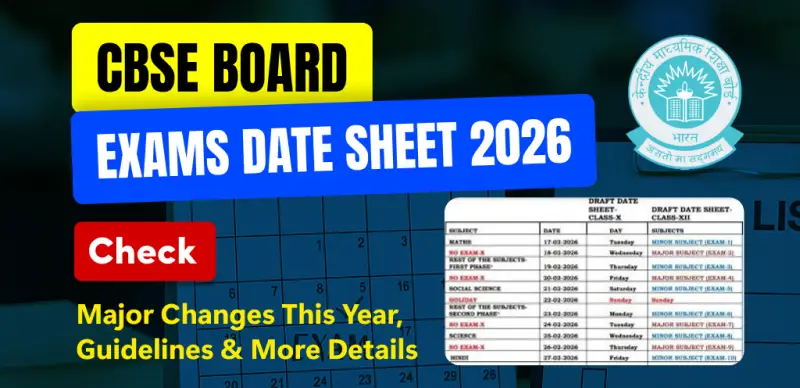
The Central Board of Secondary Education (CBSE) has introduced several major reforms that will come into effect from the 2026 board examinations. These changes are designed to reduce student stress, promote continuous learning, and align board assessments with the National Education Policy (NEP) 2020.
1. Two Board Exams per Year for Class 10
Starting 2026, Class 10 students will get two opportunities to appear for the board examination within the same academic year.
- First Exam: Mandatory for all students, held around February–March.
- Second Exam: Optional, held later in the year, mainly for improvement or to clear up to three subjects.
The best score out of the two attempts will be counted.
However, students absent in more than three subjects in the first exam will be marked as Essential Repeat and will not be allowed to take the second session.
2. Minimum 75% Attendance Made Compulsory
CBSE has made it clear that students of Classes 9 to 12 must have at least 75% attendance to be eligible for the board exams.
- Schools must track attendance closely.
- Students falling short must provide valid reasons, such as medical certificates.
- Without valid documentation, students will not be permitted to appear in the board examination.
This rule also aims to reduce absenteeism and discourage the misuse of dummy admissions.
3. Two-Year Academic Structure
CBSE has officially declared that board exam eligibility is based on a two-year learning cycle:
- Class 9 + Class 10 form one cycle
- Class 11 + Class 12 form another cycle
Students must complete this full cycle, including attendance and internal assessments, to sit for the final board exams.
4. Higher Weightage to Internal Assessments
Internal evaluations will now play a more significant role. These include:
- Unit tests
- Projects
- Assignments
- Class participation
Students must complete all internal assessments to be eligible for final results.
5. Revised Grading and Question Paper Pattern
From the 2026 session:
- A 9-point grading scale (A1 to E) will be used.
- Question papers will include more competency-based questions, such as analytical tasks, case studies, and real-life application questions.
- The aim is to test understanding, not memorisation.
6. Provisional Admission to Class 11
Students may be given provisional admission in Class 11 based on their performance in the first board exam.
Their admission will be confirmed after the final board result, including improvement attempts.
Why These Reforms Matter
These changes signal a shift toward a more flexible and student-centred education system. With two board exam chances and a greater focus on internal assessments, students get more room to improve their scores while reducing exam-related pressure. Stricter attendance and continuous evaluation encourage consistent learning throughout the year.




Thank you a lot for sharing this with all of us you really realize what you are speaking approximately! Bookmarked. Kindly also discuss with my web site =). We may have a hyperlink trade agreement among us!
Wow! Thank you! I permanently needed to write on my website something like that. Can I take a portion of your post to my site?
Glad to be one of the visitors on this awesome site : D.
It’s really a great and useful piece of info. I’m glad that you shared this helpful info with us. Please keep us informed like this. Thanks for sharing.
I am now not sure the place you’re getting your info, however great topic. I must spend some time finding out more or working out more. Thanks for magnificent info I used to be searching for this info for my mission.