CBSE’s On-Screen Marking Faces Heat After Class 12 Results Trigger Student Backlash
The declaration of the CBSE Class 12 Results 2026 has sparked a nationwide debate over the board’s newly introduced On-Screen Marking (OSM) system. While the Central Board of Secondary Education defended the digital evaluation process as a step towards greater efficiency and transparency, thousands of students and parents have questioned the accuracy of the marking after reporting unexpectedly low scores.
What Is On-Screen Marking (OSM)?
For the first time on a large scale, CBSE implemented a fully digital evaluation system for Class 12 answer sheets this year. Under OSM, physical answer booklets are scanned and uploaded digitally, allowing evaluators to assess papers online instead of manually handling physical copies.
According to CBSE, the move was designed to:
- Speed up the evaluation process
- Reduce manual calculation errors
- Improve transparency
- Ensure better monitoring of evaluators
- Prevent loss or damage of answer sheets
The board reportedly evaluated nearly 98 lakh answer scripts digitally with the help of over 70,000 examiners across India.
Why Are Students Upset?
Soon after the results were announced, social media platforms were flooded with complaints from students claiming their marks were significantly lower than expected. Many students alleged that their internal performance, pre-board scores, and competitive exam results did not match their final CBSE marks.
One widely discussed example involved a student who reportedly secured a 97 percentile in JEE Main but scored only 67% in the CBSE board examinations.
Students and parents raised concerns including:
- Unchecked diagrams and graphs
- Missing pages during scanning
- Important steps allegedly overlooked
- Inconsistency in marking standards
- Sudden drop in marks despite good academic records
Several parents also questioned whether scanned copies may have failed to capture answers written near margins or at page edges.
Pass Percentage Drops This Year
The controversy has gained more attention because the overall CBSE Class 12 pass percentage fell to 85.20% this year, a decline of 3.19% compared to last year’s 88.39%.
Education experts believe the drop may be linked to:
- Tougher examination papers
- Stricter evaluation patterns
- The transition to digital marking
However, despite the decline, more than 94,000 students still scored above 90%, and over 17,000 students crossed the 95% mark.
Educators Raise Concerns Too
The criticism has not come only from students. Several educators have also questioned whether the rapid digital evaluation process may have affected fairness.
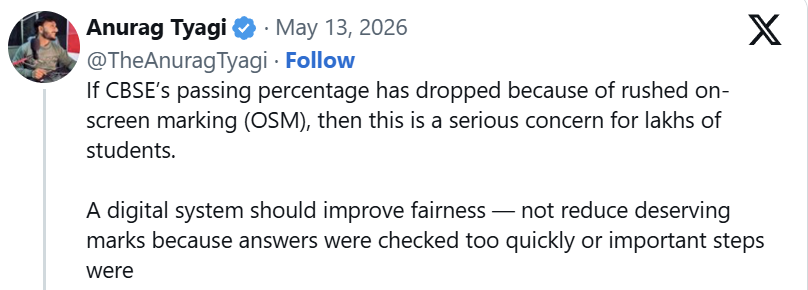
A physics educator cited in reports argued that “a digital system should improve fairness, not reduce deserving marks because answers were checked too quickly or important steps were overlooked.”
Teachers have additionally pointed out that science subjects involving lengthy derivations, diagrams, and numerical steps may require more careful human evaluation than what fast-paced digital systems currently allow.
CBSE Defends the Digital Shift
Despite the backlash, CBSE continues to maintain that OSM improves overall reliability. The board says the system automatically flags unchecked questions, reduces clerical mistakes, and standardises marking schemes more effectively than traditional methods.
The board also emphasised that digital evaluation is part of a broader push toward modernising India’s examination system and reducing dependence on paper-based workflows.
Students Turning to Verification and Re-evaluation
Following the results, many students are now expected to apply for:
- Verification of marks
- Photocopies of evaluated answer sheets
- Re-evaluation requests
Parents and educators are demanding greater transparency in the evaluation process, especially regarding scanned answer scripts and examiner review procedures.
The Bigger Question
The controversy surrounding CBSE’s On-Screen Marking system reflects a larger issue in India’s education system — balancing technological efficiency with fairness and human accuracy.
While digital evaluation may represent the future of board examinations, the 2026 results have shown that implementation challenges can directly affect student confidence and academic futures. For lakhs of students competing for admissions into top colleges and professional courses, even small discrepancies in marks can have major consequences.
As scrutiny over OSM grows, CBSE may now face increasing pressure to refine the system, improve transparency, and reassure students that technology is helping — not hurting — the evaluation process.